Which States License Radon Measurement Professionals
Radon testing is not regulated the same way in every state. Some states require radon measurement professionals to hold a specific license or certification, while others have no formal requirements. In regulated states, inspectors typically must complete a training course, pass an exam, and renew their credentials on a regular cycle. These states may also require proof of device calibration or participation in proficiency programs.
States such as New Jersey, Illinois, Ohio, and Pennsylvania have established licensing programs for radon testers. In these states, only credentialed individuals are permitted to set up devices, collect samples, and report results for real estate transactions. In other regions, inspectors can offer radon testing without a specialized license, but may still face client and agent expectations regarding protocol and documentation.
For those operating in unregulated states, national certifications, such as those offered by recognized associations, can build credibility with clients and agents who are familiar with EPA standards. Inspectors should check with their state health department or environmental agency to confirm requirements before advertising radon testing as an add-on service.
Keep reading: Roof Access Compared: Walking, Drone, Ladder, and Ground Level
Continuous Monitors vs Charcoal Canisters: Cost per Test
Radon testing devices fall into two main categories: continuous monitors and passive charcoal canisters. Each has its own workflow, upfront investment, and operating cost, which can affect what you charge and how you schedule your inspection days.
Continuous Radon Monitors (CRMs)
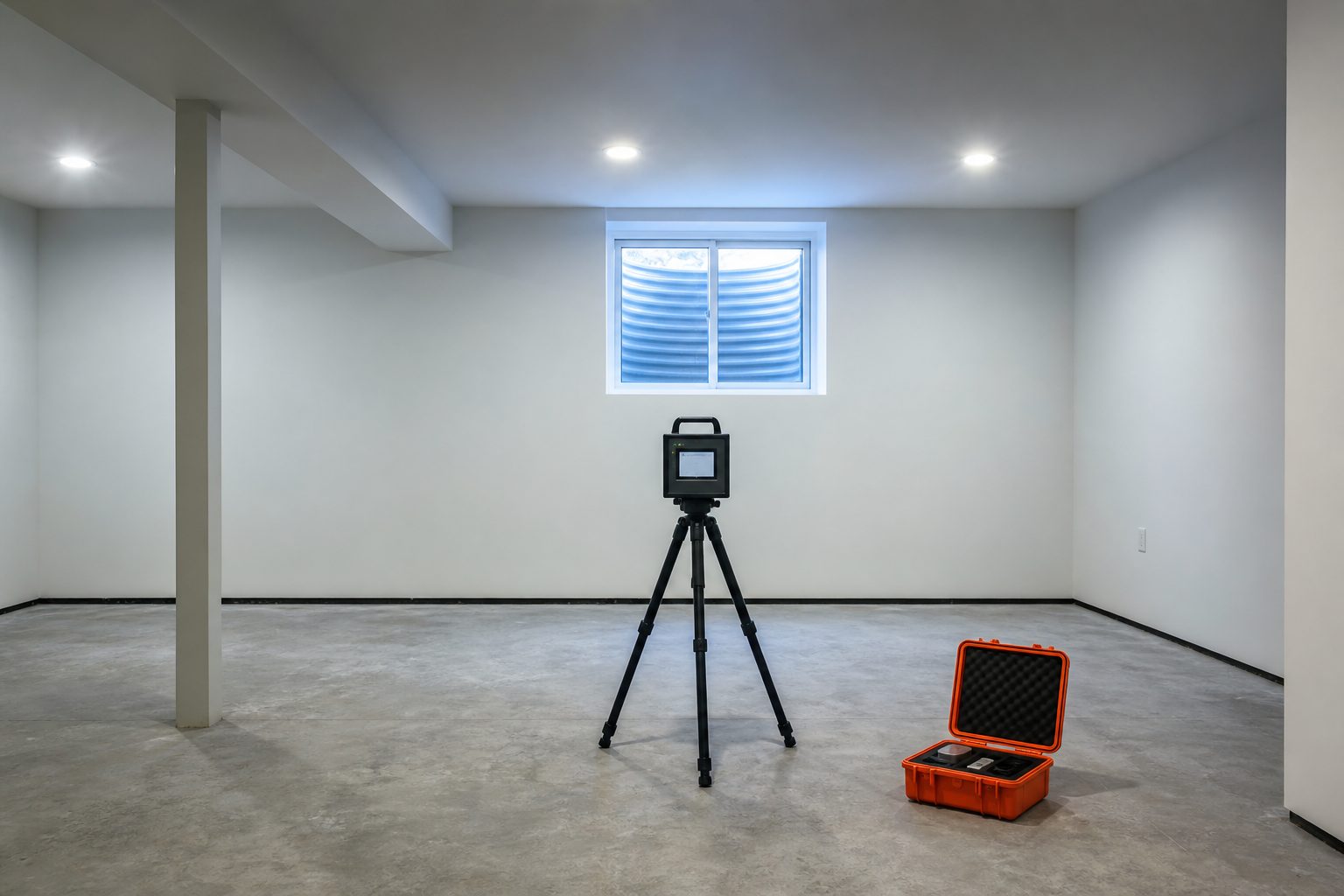
CRMs are electronic devices that log radon levels at set intervals, usually hourly. These units require a significant upfront purchase, but the ongoing cost per test is low. Maintenance includes annual calibration, which is required in many states and by most device manufacturers. Many inspectors choose CRMs for their fast turnaround and data-rich reports. You place the monitor at the inspection, retrieve it after the test, and often download a digital report that can be shared with clients and agents.
The cost per test is mainly your travel time, calibration, and power (if using plug-in units). Over the life of the device, the per-test cost drops, especially if you run several units in rotation. CRMs are accepted by state programs and by relocation companies. Some models include motion or tamper detection, which helps ensure compliant testing conditions.
Charcoal Canisters
Charcoal canisters are a passive option. They come as sealed kits that you open and place in the home. After the exposure period, you reseal the canister and ship it to a certified laboratory. The lab analyzes the sample and provides a report, usually within a day or two of receipt. The upfront cost is low, but you pay for each kit and lab analysis. Shipping costs add up, especially for expedited service.
Charcoal canisters are lightweight, require no calibration, and are easy to deploy in bulk. Labs provide chain-of-custody documentation and can send results directly to you or the client. However, the process requires careful timing, secure packaging, and sometimes extra trips if the shipping window does not line up with your route.
Many inspectors keep both options available: CRMs for convenience and speed, canisters for backup or when monitors are all deployed. The choice often comes down to volume, upfront budget, and client expectations for speed.
Setting Closed House Conditions Twelve Hours Before Deployment
No radon test result is valid for a real estate transaction if the home's air has not been properly isolated according to EPA protocol. The EPA and most state programs specify that "closed house conditions" must be maintained for at least twelve hours before placing the test device and throughout the test period.
This means all exterior doors and windows should remain shut, except for normal entry and exit. Attic fans, whole house fans, and window fans should be off. Air conditioning can run as long as it circulates inside air only. Fireplaces and wood stoves must not be used unless they are the primary heat source. This protocol mimics the typical living environment and ensures the reading reflects the home's actual radon potential.
Before scheduling, inspectors should educate buyers, sellers, and their agents about this requirement. A simple handout or email explaining the need for closed house conditions can prevent invalid tests. If the seller cannot guarantee compliance, the test should be rescheduled. Some inspectors call or text the day before to confirm the house will be closed up.
Document the client's acknowledgment of these rules. If you arrive and find a window open, you must delay deployment or note the breach in your report. In some states, failure to document closed house conditions can void your authority to report the result as official.
Keep reading: Report Wordings That Turn a Home Inspection Into a Claim
Placement Rules: Lowest Livable Level, Distances, and Height
Proper device placement is as important as the equipment itself. Most protocols require the test to be conducted on the lowest level of the home suitable for occupancy, whether finished or unfinished. This means a basement, if it is connected to the rest of the house and could be used as living space.
EPA and state guidelines specify how far the device must be from walls, exterior doors, and windows, usually at least 3 feet from doors and windows, 1 foot from outside walls, and 20 inches above the floor. The device should not be placed in kitchens, laundry rooms, bathrooms, or crawlspaces. Avoid locations near vents, return registers, or areas with high humidity.
If the home has multiple foundation types (for instance, a basement and a crawlspace), place the device in the area most likely to be used as living space. In multi-family buildings, each unit should be tested separately. Always record the location in your report, using sketches or annotated photos to document compliance.
Many inspectors use a checklist or template to confirm placement meets the protocol. Some CRMs have built-in guides or app prompts to help with placement decisions. Charcoal canisters should be labeled with start and stop times, and their position should be marked on a floor plan or using a photo for your records.
The 48 Hour Window and Retrieval Logistics
Most real estate transactions require a minimum 48-hour measurement period. Some protocols allow a test to run longer, but not less. This means you must return to the property to retrieve the monitor or charcoal canister after the exposure period.
For solo operators or small teams, efficient route planning is essential. Scheduling the retrieval trip at the time of deployment, ideally during the initial inspection, helps avoid missed windows. Many inspectors use calendar reminders or route mapping tools to streamline pickups, especially if running multiple tests per week.
Clients and agents often expect quick turnaround. If you use CRMs, you can generate a report the same day you pick up the device. With charcoal canisters, factor in shipping time and lab processing. Some labs offer overnight processing, but this is rarely included in the basic kit price.
Weather events, access delays, or client travel can push a test outside the ideal window. Some devices can store data for longer periods, but you must note any deviation from the protocol in your report. Scheduling buffer time for retrieval, especially on weekends or holidays, can prevent last-minute problems.
Inspectors operating in busy markets often purchase additional monitors or canisters to allow for overlapping deployment and retrieval, preventing idle days between jobs.
See how SlabToRoof handles this for home inspection
Reporting Results Against the 4.0 pCi/L Action Level
The EPA recommends action if the radon concentration in a home is at or above 4.0 picocuries per liter (pCi/L). Your report should clearly state the measured value, the action level, and whether mitigation is recommended. Many agents and buyers will expect a simple summary, but full compliance requires more detail.
A compliant report includes: the test location, device type and serial number, start and stop times, confirmation of closed house conditions, and the numeric result. If the test was invalid due to protocol violations, this must be disclosed. Many states require the report to include your radon measurement credential number and the date of last device calibration.
For continuous monitors, attach the data chart showing hourly readings. Spikes or dips may indicate tampering or changes in ventilation. For charcoal canisters, include the lab's analysis report and chain-of-custody form.
If the level is above 4.0 pCi/L, advise the buyer to consult a licensed mitigation contractor. Do not suggest mitigation methods unless you hold a radon mitigation credential. For results below 4.0, note that the EPA still recommends considering mitigation at any level between 2.0 and 4.0 pCi/L, but it is not required.
Keep a digital copy of every radon report for your records. Some inspectors annotate photos of the device in place to document compliance, which can be useful if results are ever challenged.
Pricing, Scheduling, and the Second Trip Problem
Radon testing can be a profitable add-on, but only if you account for your time and the logistics of a second visit. The cost to the client typically covers device use, data analysis, travel, and reporting. Many inspectors set pricing based on the type of equipment, distance traveled, and whether same-day reporting is available.
The "second trip problem", the need to return to the property for device retrieval and reporting, can eat into margins if not managed. Some inspectors group tests by neighborhood or coordinate retrievals with other scheduled inspections. In markets with distant or rural properties, you may need to charge extra for travel.
If you use continuous monitors, you can often deliver the report the same day as retrieval, which agents appreciate. Charcoal canisters extend the turnaround due to lab shipping. For both, building a buffer day into your schedule helps avoid delays for the client. Some inspectors offer rush service for an additional fee, but this depends on device availability and lab processing times.
Clients and agents expect clear communication about the testing and reporting timeline. Automated reminders or online scheduling tools can help manage expectations and reduce missed appointments.
Home inspectors who assemble reports, annotate photos, and deliver branded results to agents and buyers on the same day can turn radon testing from a logistical headache into a reliable revenue stream. Using a software platform that organizes inspections, automates report assembly, and tracks device deployment reduces errors and saves valuable time, allowing solo and two-person shops to efficiently add radon testing to their standard offerings.